


Optimex
Custom Cryogenic Pump Manufacturer for LNG and Liquefied Gases
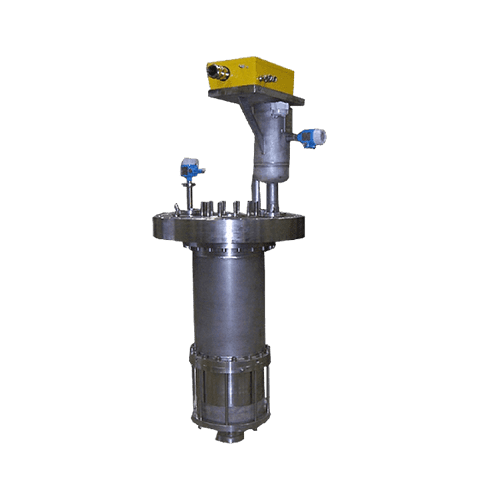
OPTIMEX designs and manufactures custom cryogenic pumps for demanding applications involving LNG, liquefied gases, industrial gas processes, cryogenic storage and other critical low-temperature services.
As a specialist cryogenic pump manufacturer, OPTIMEX develops engineered pumping solutions for applications where fluid containment, low-temperature performance, hydraulic reliability and installation constraints require more than a standard off-the-shelf pump.
Our sealless canned motor pump technology eliminates the conventional dynamic shaft seal, while our specific wet-stator cryogenic motor design enables specialized submerged and in-tank pump configurations for demanding cryogenic applications.
Each pump can be engineered according to the pumped fluid, operating temperature, flow rate, Total Dynamic Head (TDH), available NPSH, pressure, materials, electrical requirements and installation configuration.
From initial pump specification through engineering, manufacturing, testing and technical support, OPTIMEX works with EPC contractors, process engineers, equipment specifiers and industrial end users to develop cryogenic pumping solutions matched to their operating conditions.

Cryogenic Applications
Sealless and Canned Motor Pumps for Cryogenic Applications
Sealless cryogenic pumps provide a major advantage when handling extremely cold, volatile, flammable or difficult-to-contain liquefied gases: they eliminate the dynamic shaft seal found in conventional centrifugal pumps.
At cryogenic temperatures, mechanical sealing systems can be exposed to demanding conditions caused by thermal contraction, temperature gradients, low fluid viscosity and changes in material behavior. When the pumped fluid is LNG or another hazardous liquefied gas, preventing external leakage becomes an important part of pump design and selection.
By integrating the pump and motor into a hermetically contained configuration, canned motor cryogenic pumps eliminate the need for a conventional shaft penetration between the pumped fluid and the surrounding environment.
For cryogenic applications, this sealless architecture can provide important benefits in terms of fluid containment, reliability, maintenance and installation flexibility.
Conventional centrifugal pumps typically use a rotating shaft to transmit power from an external motor to the pump impeller. Where this shaft passes through the pump casing, a mechanical seal is required to contain the pumped fluid.
The mechanical seal therefore represents a dynamic sealing interface and a potential wear and leakage point.
This can become particularly challenging in cryogenic pump applications, where seals and surrounding components are subjected to extremely low temperatures, thermal cycling and dimensional changes caused by thermal contraction.
A sealless pump removes this dynamic shaft sealing interface.
In a canned motor pump configuration, the pump and electric motor are integrated into a single unit, allowing torque to be transmitted to the impeller without an external rotating shaft passing through the pressure boundary.
For applications such as LNG transfer, liquefied gas handling and other critical cryogenic services, these characteristics can make sealless technology particularly attractive compared with conventional mechanically sealed pump designs.
Cryogenic fluid containment is a critical consideration when handling liquefied gases that may be flammable, volatile, oxidizing or otherwise hazardous.
Liquefied natural gas, for example, combines extremely low operating temperature with flammability and rapid vaporization if released into warmer surroundings. Other cryogenic fluids present different hazards and therefore require application-specific containment and safety considerations.
A sealless cryogenic pump eliminates the dynamic mechanical seal and its associated external leakage path.
The integrated motor-and-pump architecture provides a hermetically contained pumping configuration designed to keep the process fluid within the pump pressure boundary.
This is particularly relevant for applications involving:
- LNG and liquid methane,
- liquid nitrogen and other industrial gases,
- volatile liquefied gases,
- flammable cryogenic fluids,
- hazardous low-temperature process fluids,
- critical cryogenic transfer applications.
For plant operators, EPC contractors and process engineers, enhanced containment can also contribute to broader operational objectives such as reducing fugitive emissions, limiting product losses and minimizing maintenance interventions associated with shaft sealing systems.
However, sealless design does not eliminate the need to evaluate the complete pumping system. Materials compatibility, connections, piping, instrumentation, operating conditions and project-specific safety requirements must all be considered when engineering a cryogenic installation.
OPTIMEX has developed a specific wet-stator motor design for cryogenic pumping applications.
Unlike conventional dry-stator canned motor designs where a containment shell separates the stator from the pumped fluid, the OPTIMEX wet-stator configuration allows the rotor and stator to operate immersed in the pumped cryogenic liquid.
The electrical components are protected by a specialized encapsulation system compatible with the operating environment, while the cryogenic liquid participates directly in motor cooling.
This architecture provides several advantages for demanding low-temperature applications:
- no conventional mechanical shaft seal,
- direct motor cooling by the pumped cryogenic liquid,
- compact integrated pump-and-motor design,
- fully submerged pump configurations,
- suitability for installation directly inside certain cryogenic storage tanks,
- reduced external leakage paths,
- adaptation to demanding low-NPSH cryogenic applications,
For submerged installations, the complete pump and motor assembly can be positioned directly in the cryogenic liquid, providing an in-tank cryogenic pumping solution particularly relevant to certain storage and transfer applications.
The wet-stator architecture must nevertheless be engineered according to the specific fluid and operating conditions. Temperature, pressure, fluid properties, electrical requirements, materials compatibility, thermal balance and hydraulic performance all need to be evaluated for each cryogenic pump application.
By combining sealless pump technology with wet-stator motor engineering, OPTIMEX can develop specialized cryogenic pumping solutions for applications where fluid containment, low-temperature operation and custom engineering are key project requirements.
Storage tank
Submersible and In-Tank Cryogenic Pumps for Storage Tanks
Submersible cryogenic pumps are designed to operate directly inside storage tanks containing liquefied gases or other extremely low-temperature fluids. This in-tank pump configuration can provide significant advantages when conventional external pump installations are constrained by available NPSH, tank geometry, suction piping or fluid containment requirements.
By installing the pump and motor assembly directly in the cryogenic liquid, the pumping unit remains submerged and close to the source of the fluid. This can simplify the suction arrangement, reduce external piping requirements and support reliable liquid withdrawal from cryogenic storage tanks.
OPTIMEX has developed fully submerged sealless cryogenic pump configurations based on its wet-stator motor technology. Depending on the application, this architecture can be engineered for cryogenic storage and transfer duties where low NPSH, containment and low tank-level operation are important project requirements.
An in-tank cryogenic pump is installed directly inside the cryogenic storage vessel rather than externally at ground level or alongside the tank.
In a fully submerged configuration, the pump and motor assembly operates immersed in the pumped cryogenic liquid. This eliminates the need for a conventional external motor shaft and dynamic mechanical seal.
A particularly important advantage is the possibility of reducing or eliminating bottom tank penetrations and liquid connections below the maximum liquid level, depending on the overall storage system design.
This can be valuable for cryogenic fluids where containment and minimizing potential external leakage points are major design objectives.
The submerged architecture can be considered for applications involving LNG storage tanks and other cryogenic or liquefied gas storage systems, subject to validation for the specific fluid and operating conditions.
Pump accessibility, installation method, maintenance strategy and tank configuration must also be considered during engineering. An in-tank solution is therefore selected as part of the overall cryogenic storage and transfer system, rather than as an isolated pump component.
Low NPSH performance is particularly important when pumping cryogenic liquids from storage tanks.
Liquefied gases are often stored close to their boiling or saturation conditions. A reduction in pressure at the pump inlet can therefore cause part of the liquid to vaporize, increasing the risk of flashing, cavitation and unstable pump operation.
Installing a submersible cryogenic pump directly inside the storage tank can help improve suction conditions by positioning the pump inlet within the liquid and reducing the suction losses associated with conventional external piping.
For applications with particularly limited available NPSH, OPTIMEX can also integrate an inducer upstream of the impeller.
An inducer is an axial-flow hydraulic component designed to increase pressure before the fluid reaches the main impeller. Its purpose is to reduce the NPSH required (NPSHr) by the pump and improve operation under challenging inlet conditions.
Combining an in-tank pump configuration with low-NPSH hydraulic design can therefore be particularly valuable for cryogenic storage applications where the available static liquid head decreases as the tank is emptied.
The final pump configuration must nevertheless be validated according to the fluid properties, tank pressure, operating temperature, required flow rate, total dynamic head and minimum operating liquid level.
Maintaining pump operation as the liquid level decreases can be an important requirement for cryogenic storage tank withdrawal and emptying applications.
As the tank level falls, the static liquid head available at the pump inlet decreases. This reduces NPSHa and can make stable pumping increasingly difficult, particularly for cryogenic fluids operating close to their vapor pressure.
A submersible low-NPSH cryogenic pump can be engineered to support liquid withdrawal under these demanding conditions.
Positioning the pump inlet near the bottom of the storage tank maximizes the available liquid head, while an optimized inlet design and, where required, an inducer can help reduce NPSHr.
For certain OPTIMEX cryogenic pump configurations, the use of an inducer can support operation with a very low liquid level above the pump inlet, making this architecture particularly relevant for demanding storage tank applications.
The achievable minimum liquid level is not a fixed value for every installation. It depends on the fluid, tank geometry, operating pressure, flow rate, pump hydraulics, NPSH margin and installation configuration and must therefore be determined during pump and system engineering.
For LNG and other liquefied gas storage applications, combining submersible installation, sealless technology and low-NPSH hydraulic design provides an engineered approach to safe and efficient cryogenic liquid withdrawal.
Custom pumps
Custom Cryogenic Pumps and Engineered Pumping Solutions
Cryogenic pumping applications often require more than a standard off-the-shelf pump. Extreme temperatures, low available NPSH, volatile or hazardous fluids, specific tank configurations and demanding hydraulic duties can require a custom cryogenic pump engineered around the actual operating conditions of the project.
As a specialist cryogenic pump manufacturer, OPTIMEX develops engineered pumping solutions for applications where fluid containment, low-temperature performance and reliability are critical.
Rather than selecting a standard pump solely from a catalog, OPTIMEX evaluates the fluid properties, operating temperature, flow rate, Total Dynamic Head (TDH), NPSH, pressure, materials, installation configuration and electrical requirements to define a solution adapted to the application.
This engineering-driven approach allows OPTIMEX to address specialized requirements involving LNG, liquefied gases, industrial gas processes, cryogenic storage and other critical low-temperature applications.
Every custom cryogenic pump project begins with a detailed analysis of the process conditions and required operating envelope.
Cryogenic pump engineering must account for the interaction between hydraulic performance, thermodynamic behavior, mechanical design, materials and motor technology.
Key project data evaluated during the engineering phase can include:
- pumped fluid and fluid composition;
- minimum, normal and maximum operating temperature;
- minimum, normal and maximum flow rate;
- suction and discharge pressure;
- required Total Dynamic Head;
- fluid vapor pressure;
- available NPSH;
- minimum and maximum tank liquid levels;
- continuous, intermittent or variable operating duty;
- installation and space constraints;
- materials compatibility;
- electrical supply and motor requirements;
- hazardous area requirements where applicable;
- instrumentation and monitoring requirements.
For cryogenic fluids, hydraulic sizing must also be considered together with thermal behavior.
Heat introduced by the motor, hydraulic losses or the surrounding environment can affect the condition of a liquefied gas and potentially promote vaporization. OPTIMEX therefore considers thermal balance as part of the cryogenic pump engineering process to verify that the proposed design is compatible with the required operating conditions.
Where available NPSH is limited, the hydraulic configuration can also be evaluated to address demanding suction conditions. Depending on the application, solutions can include submersible pump installation, in-tank configurations or an inducer designed to reduce NPSHr.
This application-specific engineering approach enables the cryogenic pump to be designed around the complete system requirements, rather than treating flow rate or discharge pressure as isolated selection criteria.
Control of the complete pump development process is particularly important for custom cryogenic pumping equipment, where hydraulic, mechanical, electrical and thermal performance are closely interconnected.
OPTIMEX manages key stages of its pump development and production process in-house, from engineering and design through manufacturing, assembly and testing.
Its capabilities include:
- hydraulic and mechanical engineering,
- pump and motor design,
- component manufacturing and machining,
- motor winding,
- electrical component encapsulation,
- rotor balancing,
- pump and motor assembly,
- performance testing,
- final inspection and quality control,
This integrated manufacturing approach allows the different elements of a sealless cryogenic pump to be developed as a complete system.
For OPTIMEX wet-stator cryogenic technology, the relationship between the hydraulic section, motor, encapsulated electrical components and pumped fluid is particularly important because the motor operates in direct contact with the cryogenic liquid.
Keeping core engineering and manufacturing capabilities under direct control also facilitates the development of custom pump configurations when standard dimensions, hydraulics, materials or installation arrangements cannot meet the project requirements.
Testing forms an essential part of this process.
Depending on the pump and project specification, testing can be used to verify parameters such as hydraulic performance, flow rate, head, electrical behavior, vibration, leak tightness and overall operating performance before delivery.
Project-specific inspection, testing and documentation requirements can also be defined according to the end user’s specifications and applicable contractual requirements.
A custom cryogenic pump becomes particularly relevant when the application falls outside the operating envelope of conventional catalog equipment.
OPTIMEX can adapt the hydraulics, motor, materials, pump orientation and installation configuration according to the requirements of the application.
This engineering capability is particularly relevant for critical cryogenic applications involving LNG storage and transfer, industrial gases, Air Separation Units, cryogenic process plants and specialized low-temperature installations.
For projects involving emerging or particularly demanding fluids and markets — including liquid hydrogen, LOX, aerospace or space-related cryogenic applications — the required pump configuration and suitability must be specifically evaluated and validated according to the fluid, operating envelope, applicable standards and project requirements.
The objective is not simply to supply a cryogenic pump, but to provide an engineered pumping solution matched to the process conditions and installation constraints of the project.
For EPC contractors, process engineers, equipment specifiers and industrial end users, this custom approach provides a direct path from the cryogenic pump specification and duty point to engineering, manufacturing, testing and project support.
Critical applications
OPTIMEX Cryogenic Pump Manufacturer for Critical Applications
Choosing the right cryogenic pump manufacturer means working with a partner capable of understanding not only pump hydraulics, but also the thermal, mechanical and containment challenges of extremely low-temperature fluids.
OPTIMEX combines cryogenic engineering expertise, sealless canned motor technology and custom pump design to develop pumping solutions for demanding applications involving LNG, liquefied gases, industrial gas processes, cryogenic storage and other critical low-temperature services.
From initial pump specification through engineering, manufacturing, testing and technical support, OPTIMEX works with EPC contractors, process engineers, equipment specifiers and industrial end users to develop a solution matched to each project’s operating conditions.
Discuss Your Cryogenic Pump Application with OPTIMEX
Looking for a cryogenic pump, LNG pump, sealless cryogenic pump or custom low-temperature pumping solution?
Our engineering team can review your application and help define a cryogenic pumping solution adapted to your process and operating conditions.
Have a cryogenic pumping project? Contact OPTIMEX to discuss your application and request a technical proposal.